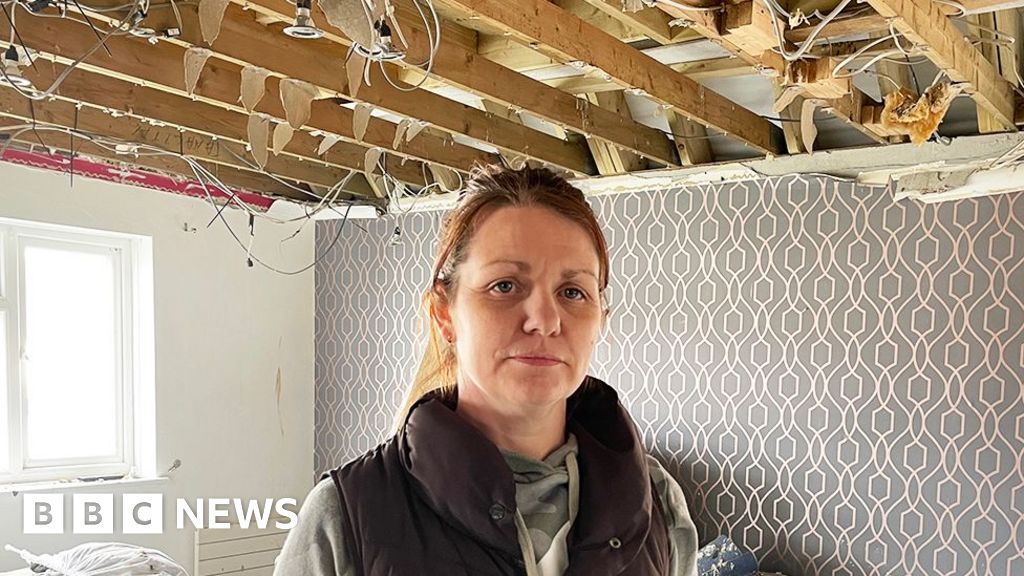

A mother and her teenage son are facing a fourth Christmas of homelessness after building contractors, working for the freeholder at their block of flats, left their home uninhabitable.
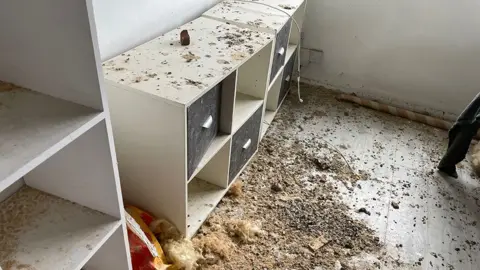
A botched roof extension caused the ceiling to collapse at Kate Morris’s top-floor flat in Ashford, Surrey. A pigeon infestation followed, leaving every room covered in bird droppings.
“It’s been devastating, it’s completely ruined our lives,” she says.
Kate is one of more than 1,000 leaseholders who have contacted the BBC in the past year about disputes and concerns involving the leasehold system.
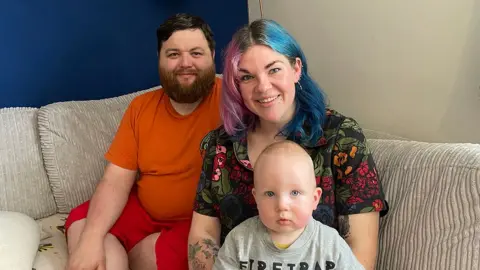
Another flat on the top floor was also damaged by the works. The owners, Laura and Tom, still live in the block, although they have no idea how safe it is.
They have a small child, George, and say they hate the fact their “happy smiley baby” has to live there.
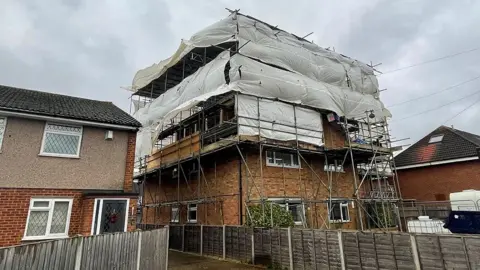
Work was stopped by the Health and Safety Executive (HSE) after a number of safety breaches. The building remains unfinished and the surrounding land is littered with debris.
Kate, Laura, Tom and another leaseholder have tried to pursue the matter in the courts, but so far, they say they have had little to show for their efforts.
Earlier this year, the leaseholders were even ordered to pay £7,000 legal costs to the businessman they blamed for the works.
‘Raining inside’
In 2021, Kate had been about to sell her two-bedroom flat. It was one of six properties in a two-storey block.
Weeks before the sale went through, she received what she describes as a “forthright” letter to say the building’s freehold had been sold, with planning permission to build two more flats on the existing roof – in other words, directly above the flats owned by Kate, Laura and Tom.
As the law currently stands, the freeholder of a property generally owns the building and the land beneath it, outright and forever. Leaseholders effectively buy the right to live in the property for a fixed period of time.
The system has its origins in the Middle Ages, when rich landowners granted tenants the right to work an area of land.
Kate told us she wrote back to the new freeholder, Magnitude Developments Ltd, and its owner Ameen Raza, asking for clarity about the proposed works. She did not get any answers, she says, and her buyer consequently pulled out of the sale.
Work on the roof extension began in spring 2022. There were problems with the contractors from the start, says Laura: “Every time they were on site, something happened.”

Workers were “throwing things off the roof” and putting the residents at risk, she adds. “I woke up one morning, they dropped something on our bedroom ceiling, and a piece of our ceiling fell down.”
Holes started to appear in Kate’s ceiling too. A temporary cover was put in place, but by summer 2022, this had begun to leak.
Kate feared her home was going to collapse and warned the freeholder.
“It was raining inside the building at that point,” she says.
In August 2022, her ceiling fell in.
“My furniture, TV, sentimental belongings, photos and books were just absolutely destroyed,” she says.
Kate says her home insurance company wouldn’t pay out because the property had not been watertight.
Legal documents suggest that, as a “goodwill gesture”, Magnitude offered to repair the damage if all claims against it were waived – an offer it said the leaseholders had “unreasonably” refused.
However, the leaseholders say they turned the offer down because the building work would have been carried out by the same contractors, without proof of warranty or insurance.
Safety breaches
After the damage, most of the block’s residents had to move out.
Magnitude later claimed in court that it had offered alternative accommodation while works continued, but the offer had not been taken up. Kate and Laura told us they dispute this.
Kate says she was forced to sleep on the floor at her parents’ house. Tom and Laura moved in with friends in Coventry, 100 miles from Laura’s place of work and the couple’s home.
“My mental health plummeted,” Laura says. “It was awful… it had such an impact that I just wasn’t quite prepared for.”
During that period, Laura became pregnant. She and Tom decided to return to their own flat even though works were still ongoing.
“We had a brand-new baby with bad lungs, and we wake up to a generator running above our heads and the absolutely stinking of petrol,” says Laura.
Work on the block was halted by an HSE “prohibition notice” in March 2024.
In liquidation
There is a tribunal court system for leaseholder disputes, but the case brought by Kate, Laura and another leaseholder was heard in a civil court.
When the case started in April this year, the judge said he had received a letter informing him that the freeholder, Magnitude Developments Ltd, had commenced liquidation proceedings.
There is no suggestion that the insolvency process was in any way improper.
Court documents submitted before the hearing indicate that Magnitude sought to join its contractors to the legal action, alleging that they had failed to properly protect the structure from the elements while the works took place.
Magnitude was not represented in court, and the judge ordered it to pay more than £100,000 in damages to the leaseholders.
Since the company was in liquidation, the leaseholders tried to join Ameen Raza, its former director, to their legal complaint. Their barrister argued that although Magnitude was the legal freeholder, Mr Raza had exercised significant financial control.
A second judge in a later hearing accepted there were “serious concerns” in the case, but he denied the application to make Mr Raza personally liable.
Since the leaseholders’ application had failed, he ordered them to pay Mr Raza’s legal fees, amounting to £7,000.
‘Anyone can buy a freehold’
Land Registry documents show that, by the time of the court case, Magnitude had already sold the building’s freehold for £300,000.
It was bought in May 2024 by a company called Imperial Prime Properties Ltd, which had been in business since January that year.
Imperial Prime Properties Ltd was registered to a virtual office in central London. The BBC has not been able to find a website or phone number, and the company declined to comment in writing.
“Anybody can buy a freehold,” says Katie Kendrick, founder of the National Leasehold Campaign, a group campaigning for changes to the law. “They are often sold at auctions.”
The system needs overhauling, she believes, because it is too easy for freeholders to avoid being held to account if problems arise.
The leaseholders say they feel completely “powerless” and frustrated that individual directors or shareholders of freehold companies are not liable.
Tom says he feels the system has worked in favour of the former freehold company and Mr Raza personally. “He’s hiding behind that corporate veil,” he says.
Katie Kendrick believes “leaseholders cannot defend themselves in the same way that rich, deep-pocketed freeholders can”.
The BBC has found almost £6.5m worth of property registered to Mr Raza’s family. Almost £4m worth was sold in 2023 and 2024 to companies of which Ameen Raza was a director.
Public records also show Mr Raza’s companies have earned at least £90,000 in the past five years from a local authority. His firms have provided accommodation to people subject to immigration control with no recourse to public funds, as well as a number of other social services.
Meanwhile, the leaseholders feel there is no protection for people like them.
“There’s no-one. We’re completely on our own,” Kate says.
The Leasehold and Freehold Reform Act (Lafra), which aims to “strengthen” leaseholder rights in England and Wales, was fast-tracked through Parliament before the 2024 General Election but most of its measures haven’t yet come into force.
We asked Housing Secretary Steve Reed when reforms would start protecting leaseholders like Kate, Laura and Tom.
He said he recognised that leasehold had been “a running sore” for years, and the government wanted to eliminate it within the term of this parliament. He added that announcements on further legislation were likely to be published before the end of 2025.
‘Angry and frustrated’
Kate and her son continue to live with her parents. She and the other leaseholders are still in litigation with the companies.
She says she is “incredibly angry and frustrated” that someone can “completely destroy someone’s home and walk away”.
We contacted Magnitude, Imperial Prime Properties Ltd and – via his barrister – Ameen Raza. All declined to comment.
The leaseholders’ local authority, Spelthorne Borough Council, told the BBC it has removed the pigeons and carried out “pest-proofing” in the block, and said it would try to reclaim the cost from the freeholder.
However, the building is still incomplete, with gaps where windows should be, and the leaseholders are concerned the pigeons will return.
Only three out of the six flats in the block are now occupied. None of the leaseholders can sell their properties.
Laura and Tom remain, but say they feel trapped, and hate having to raise their son in a building that most people think is “derelict”.
“We try and make the insides nice and liveable and colourful and exciting, but everything else is awful,” says Laura.
“This is not what I want for my baby.”