


 BBC
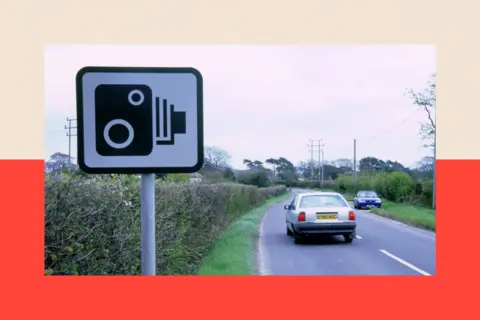
BBCI like to think of myself as a law-abiding driver. But it was not a total shock earlier this year when I received one of those official notifications in the post, informing me that I had been caught exceeding a speed limit (driving out of Wandsworth in South London, if you’re interested).
I had to accept either three driver penalty points, or attend a speed awareness course. Having no points on my licence, and wanting to keep it that way, I chose to take the course (like so many others given the choice).
And so it was, on a warm Saturday morning earlier this year, that I found myself in a London hotel conference room, with about two dozen other people learning about the dangers of speeding.
First thing to say about the course is that it is so good, it should really be compulsory for everybody who drives. It was shocking to learn of some basic confusions about the speed limits that I and others were harbouring.
But my main observation that day was that we are seeing a dramatic change in driving culture.
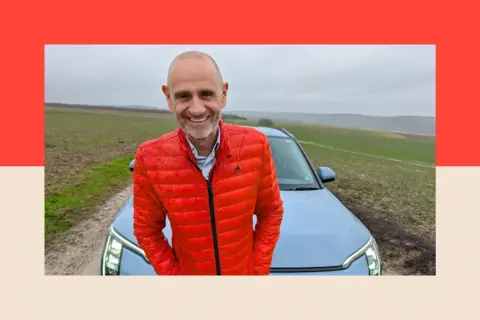
As the course instructors went around the room asking us all why we were there, it turned out that almost none of us had been driving “fast” as you might have once defined the word. Most of us had been speeding at something like 26mph. But we were unarguably guilty as charged, having breached the limit on a 20mph road.
I had not given it much thought until then, but it is clear we are in the midst of a significant lowering of urban speeds. And many motorists are struggling to keep up. (Or more accurately, slow down.)
The number of tickets issued for 20mph speed offences was almost half a million last year, according to data collated from police forces in Great Britain by campaign group, 20’s Plenty For Us.
Why do many drivers find it so difficult to keep to 20mph? As a driver myself – but also an occasional cyclist, pedestrian and resident of a neighbourhood of 20mph roads – I am increasingly fascinated by the complicated layers of debate. And how a deeper psychology and sense of habit also plays a part.
So, given the number of 20mph roads around the country, will our brains gradually adjust, making it eventually seem normal – and how can we speed that process up?
‘Frankly ludicrous – a war on motorists’
In Wales, no-one can have missed the debate over the Cardiff government’s decision to lower speed limits in built-up areas in September 2023. It became a hot political issue.
Mark Drakeford, the former First Minister and Labour politician who introduced the policy, said it would “keep people from losing their lives”; while the Welsh Conservatives called it “disastrous, frankly ludicrous and a war on motorists”.
Since then, the change has been partially unwound by the re-introduction of 30mph limits on certain roads. But with far less fanfare, swathes of the rest of the country have also moved towards a 20mph norm.
 Getty Images
Over half of London’s roads now have a 20mph speed limit, according to Transport for London (TfL). In Leeds, dozens of roads are set to become 20mph as part of the council’s “Vision Zero 2040” strategy (which aims for zero road deaths or serious injuries by 2040).
Various towns across the country are following the same path.
No-one can say this has been rushed. The first 20mph limit in the country came into effect in 1991 in the Sheffield suburb of Tinsley. Eight years later the law was changed, making it much easier for highway authorities to introduce 20mph zones. In the last decade, that change has accelerated.
And that is not only true in the UK. Across the continent, 30km/h speed limits (equivalent to 19mph) are increasingly common.
Transport planners across the West have evidently been receptive to the same arguments for making an historic change in the relationship between the car and other road users.
Psychological flow at the wheel
Figures from the Department for Transport show that in 2024, while 43% of cars exceeded the 30mph limit (and 44% exceeded 70mph on motorways), on 20mph roads, it was 76%. Yes, three-quarters of drivers break the 20mph speed limit. In fact, the average speed on 20mph roads (when they are free-flowing) was 24mph.
It has got a little better over the last few years, but still one in 10 drivers exceed the 20mph speed limit by at least 10mph.
So, what’s going on?
When I did my speed awareness course, we were asked – hands-up – why we thought we had driven too fast. People proffered sensible answers like “I was in a hurry” or “I wasn’t paying attention to the speed limit” or “someone was tailgating me”.
But for me, it was different. I felt almost silly admitting it: it is just that on a free-flowing road in a car, to me 20mph feels unnaturally, uncomfortably, slow.
Evidently, there is a lot of psychology at play.

Richard Stephens, senior lecturer in psychology at Keele University, talks of the importance of the “flow state”.
“Psychological flow is this state that we can get in when you’re on a roll or you’re in the zone, you’ve been totally absorbed in what you’re doing,” he explains.
To enter flow state, your task needs to be “enough of a challenge to engage us, but not too much of a challenge to stress us out”.
It applies to driving too, he says. “Sometimes the speed limit might feel a bit slow for the road you’re on, and you might feel a bit under-challenged. And there’s a temptation [to] put your foot down.
“In a flow analogy, what you’re doing is you’re increasing the challenge a little bit to get more into that sweet flow spot and a more enjoyable experience.”
But he argues that drivers can help themselves enter that “flow state” while sticking to 20mph. He suggests listening to something stimulating, or even turning driving into a game.
“The car I drive has a display that encourages eco-driving,” he says. “It encourages you to not accelerate too sharply, not brake too harshly, and things like that. That sort of gamification of the driving experience can add elements that would bring flow in without changing the speed that you’re driving.”
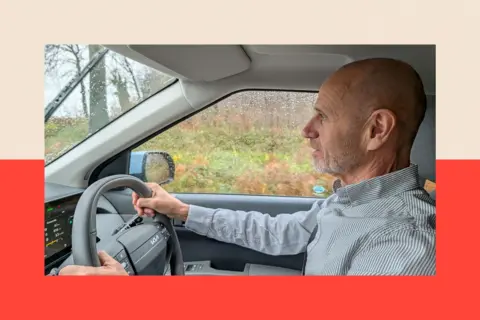
For some drivers, faster speeds are simply more satisfying.
“I do think there’s almost something inherently attractive about speed,” admits Dr Stephens. “Once a child learns to walk, then they learn to run, and then they just run everywhere, because it’s more fun.”
Then there are habits: we can habituate ourselves to speed – so fast can feel slow, and vice versa, depending on what you’re used to.
Shaun Helman, Chief Scientist at the Transport Research Laboratory, points out: “If you’re barrelling along a motorway at 70mph, the moment you leave on to the slip road and slow right down, you will notice that it suddenly feels a lot slower than you’re used to because of that short-term fast speed that you’ve been doing.”
Add to that the fact that modern cars – with their active suspension and their noise-optimised tyres – give some drivers an extra sense of security.
“Quiet cars, finely engineered for a really comfortable drive, will simply give you less perceptual cue that you’re travelling at a particular speed. So that makes it easier to slip over a limit.”
One-third reduction in collisions
Of course, there’s a clear reason why many councils have rolled out 20mph speed limits: safety.
It is obvious to most drivers that slower speeds are generally safer than fast ones. And it’s easy to see why many people, including those whose loved ones have died in accidents, might push for a lower limit.
A pedestrian who is hit by a car travelling at between 30mph and 40mph is between three-and-a-half and five-and-a-half times more likely to be killed than if hit by a car driver travelling at below 30mph, according to the Royal Society for the Prevention of Accidents, a charity.
TfL looked at more than 100 roads in London that introduced 20mph limits between 1989 and 2013.
Analysing a period of three years before, and three years after, the limit was lowered, their research suggested that 20mph limits brought a 35% reduction in collisions, as well as a 34% reduction in serious injuries and deaths.
The number of child deaths on those roads fell from a total of four to one.
 Getty Images
But, as they concede, other road safety measures were also implemented over that period, and it is difficult to pinpoint exactly what caused the improvements.
In Wales, too, the government has found a 25% reduction in the number of people injured or killed on low-speed roads in the most recent 18 months, compared with the 18 months before a speed limit reduction.
Of course, as with any knotty academic question, there are anomalies.
A study from Queen’s University Belfast in 2022 looked at 76 streets in the Northern Irish capital. It found that casualties dropped by 22% three years after 20mph speed limits were introduced – a fall, but not a statistically significant one, the study’s authors said (in other words, it could have been explained by mere chance).
 Hazel Peacock
But broadly speaking, the data shows that slower equals safer. A European meta-study from last year at the National Technical University of Athens, reviewed 70 studies of the 30km/h limits in 17 cities and found a 23% reduction in road crashes, and a 38% reduction in fatalities.
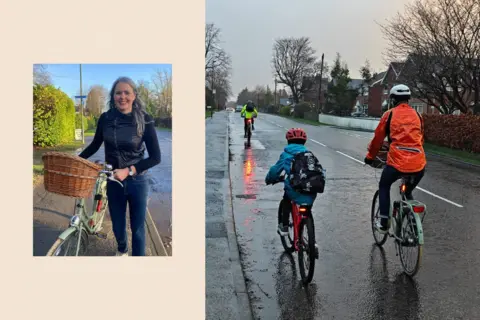
Hazel Peacock, a road safety campaigner in Harrogate, was delighted this summer when her council imposed 20mph limits on almost 200 roads in the town. She now feels safer cycling with her nine-year-old son to his school.
“It’s less intimidating,” she says. “When a driver sees you, they’re already going slower. I really think they see you as a human. They’re not having to change their behaviour or their speed when they see you.”
She also feels more comfortable letting her older son, aged 12, walk to school.
New speed-lowering technology
Looking ahead, there remains one big, unanswered question. Will our brains gradually adjust to 20mph, or will it continue to feel unnaturally slow, ensuring its survival as a hot and sometimes divisive political issue?
Mr Helman predicts most drivers will get used to it.
 Getty Images
“Once you get people behaving in a particular way, they change their outlook and their attitudes on those behaviours,” he says. “There’s this idea that your attitudes determine how you behave, and there’s an element of truth in that.
“But the opposite is also true, your behaviour actually defines your attitudes.”
And then of course, there is the really big transformation under way, with which anyone with a newish car is familiar: the technology of speed control.
“Intelligent Speed Assistance”, as it’s known, may feel like a nuisance, beeping away when you are at the wheel. But use it wisely. It can cap your speed, taking away any need for you to concentrate as you stick to the limit.
I’m happy to say that since my speeding ticket earlier this year, not only have I been schooled in the dangers of speed and the merits of driving slowly, I now have a new car, in which it takes just a quick flick of a finger to cap the speed.
Suddenly 20mph is achievable with little to no effort. My guess is that it is here to stay – if I can handle it, I think most people can.

BBC InDepth is the home on the website and app for the best analysis, with fresh perspectives that challenge assumptions and deep reporting on the biggest issues of the day. You can now sign up for notifications that will alert you whenever an InDepth story is published – click here to find out how.